


Before accepting an embedded prototype, translate its saving behavior into writes to the actual nonvolatile memory. Count normal saves, retries, startup activity and housekeeping. Then compare the busiest physical storage unit with the selected component’s endurance conditions. A device that saves successfully during a demonstration has not yet established a sustainable write budget.
For a product owner, the useful deliverable is a storage budget tied to firmware behavior: what is saved, why, how often, where it goes and what the product may lose if saving is delayed. That makes the tradeoff between persistence and wear visible before field use.
Begin with data that really needs to survive
List the stored information by purpose. Calibration values, user configuration, accumulated operating hours and diagnostic events do not necessarily need the same saving policy. A calibration value might change only during service; a running counter may change continuously.
Separate the rate at which a value changes in RAM from the rate at which it must be committed. Specify the acceptable loss window in plain terms. If a counter is checkpointed periodically, what unfinished interval could be lost after power interruption? If a setting is saved only on an explicit confirmation, what should the interface show before that confirmation?
Do not silently trade away persistence to reduce writes. Agree the behavior with the product team and test it. Financial, safety-related or legally required records need their own requirements; a convenient batching interval is not sufficient justification.
Identify the physical unit that wears
An application-level save is not automatically one independent byte write. The selected memory architecture and driver determine how logical changes become physical operations.
مثلًا، Microchip’s AT25010B/AT25020B/AT25040B data sheet (DS20006251C, Table 4-6) specifies endurance under particular temperature, voltage and page-write conditions. Its note defines write-cycle endurance for aligned groups of four data bytes. This is a device-specific example, not a universal EEPROM rule. Check the exact part and revision before budgeting.
Flash-backed EEPROM emulation is different again. ST’s AN4894 explains an implementation that appends updates, transfers valid elements when a page set fills and erases the old set. Its allocation and wear-leveling rules affect the physical cycle count. Do not treat a variable update as one page erase or assume that doubling reserved bytes always doubles useful life.
Record the program unit, erase unit where applicable, endurance conditions, retention requirements and driver version. Include metadata: sequence counters, directory entries, validity markers or a fixed status location can be written more frequently than the payload they describe.
A hypothetical write budget
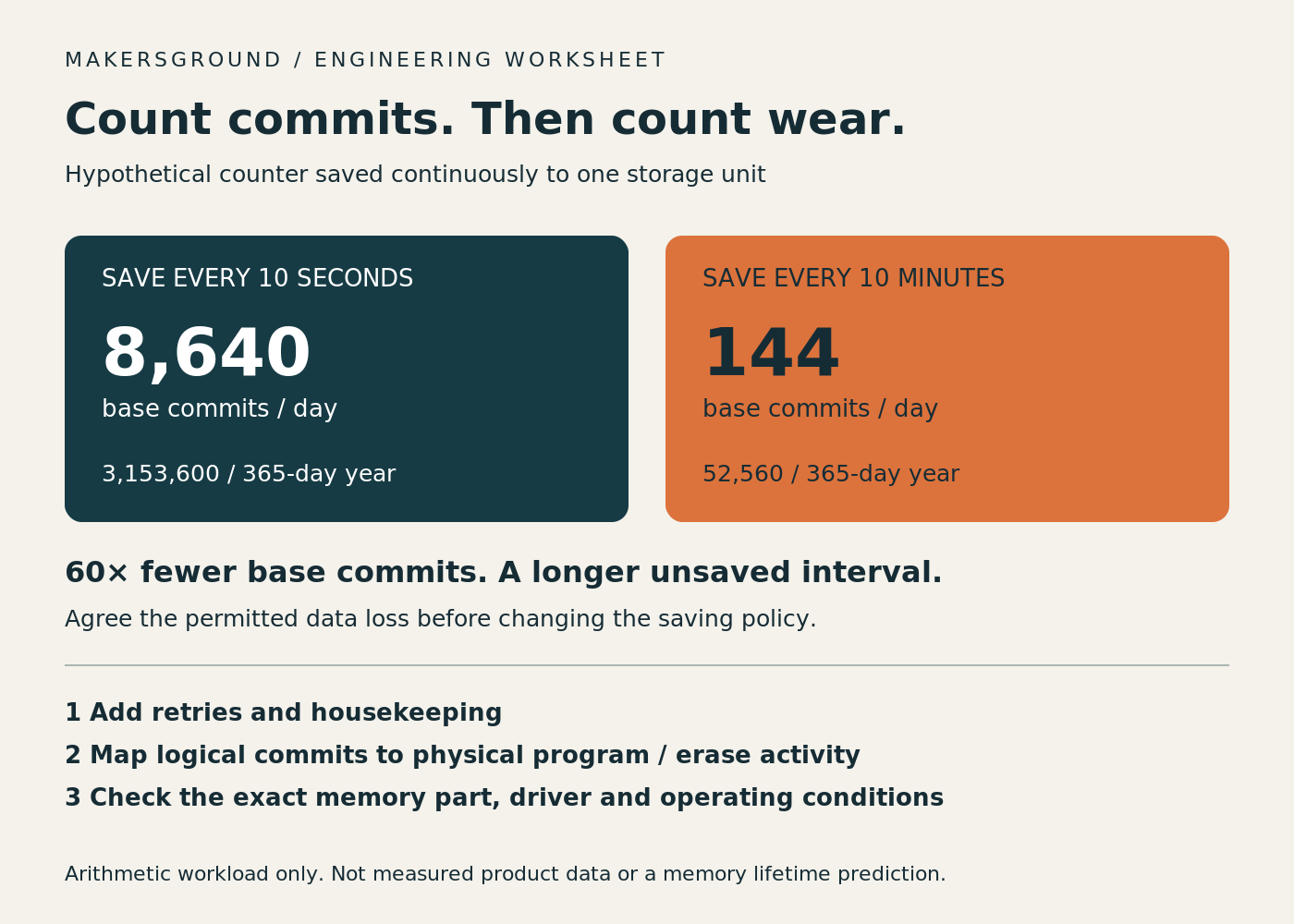
Consider a hypothetical low-voltage monitoring device that commits one counter to the same endurance unit every 10 seconds, continuously. The workload is 8,640 commits per day, or 3,153,600 over a 365-day year. These are arithmetic workload counts, not measured product data or a component lifetime prediction.
If the product instead permits a checkpoint every 10 minutes, the base workload becomes 144 commits per day, or 52,560 per year. That is 60 times fewer base commits, but it also increases the potential unsaved interval. It does not prove that the memory lasts 60 times longer: metadata, retries, physical allocation and operating conditions still matter.
Add exceptional writes separately. A reconnect loop, repeated factory-default save or a sensor fault that records the same event on every iteration may dominate the normal workload. A budget based only on intended user actions will miss these paths.
Change the policy before changing the component
First remove avoidable writes. Verify whether the software writes unchanged settings, rewrites an entire structure for one field, or retries completed work because acknowledgement handling is ambiguous. An unchanged-value comparison must use the intended representation; uninitialised padding or unstable serialization can make equivalent settings appear different.
Then consider batching or checkpointing, but retain the agreed loss window. Use distinct policies for infrequent settings and frequent events. If wear leveling is needed, review the supported driver’s storage layout and recovery behavior rather than designing a rotation scheme from capacity alone.
More storage or a different memory technology may be appropriate when the required persistence cannot fit the budget. Compare options against the actual workload and conditions, not a headline endurance number. Include software complexity, boot recovery, update compatibility and evidence needed to accept the change.
Measure the writes in the prototype
Instrument the persistence boundary so a representative test can report attempted updates, completed logical commits, physical program operations and erase operations where exposed. Keep these definitions separate. A successful API call count alone may hide internal housekeeping.
Use the same configuration, record sizes and firmware build planned for acceptance. Test normal operation, repeated setting changes, reboot sequences, communication outages, retries and a full log or storage area. Capture the hottest unit where the driver allows it. When physical counters are unavailable, document the model used to translate logical activity and validate it against the driver implementation.
Make the result reviewable:
- Memory part, revision and relevant operating conditions.
- Firmware and storage-driver versions; layout and reserved capacity.
- Data categories, update rates and maximum permitted loss windows.
- Measured logical and physical activity, test duration and fault scenarios.
- Calculated workload over the intended service period, assumptions and margin.
- Remaining tests and the person responsible for accepting the storage policy.
Keep endurance and recovery as separate acceptance questions
An endurance budget asks whether repeated storage operations fit the component and implementation. Recovery asks whether interrupted operations leave valid information that the product can interpret. Passing one does not establish the other. Use the separate قائمة التحقق لاستعادة التشغيل بعد انقطاع الطاقة for interrupted-save behavior rather than counting a successful reboot as endurance evidence.
سجل MakersGround الخاص بـ مشروع Gomicron documents mechanical design, PCB electronics, firmware and control, slicing software, prototyping and manufacturing. Storage policy is one of the questions that connects custom electronics with product behavior. This example is an engineering planning method, not a claim about Gomicron’s memory parts or historical test process. See our نطاق تطوير العتاد والبرمجيات الثابتة for the wider development context.
Before approving the next build, require a write budget that another engineer can reproduce. The important result is an agreed persistence policy backed by measured workload and exact component conditions, not a generic promise that nonvolatile memory lasts for years.
المصادر
Technical sources checked November 16, 2026, and revalidated November 17, 2026.
- STMicroelectronics AN4894, Simple use case and advanced features: EEPROM emulation layout, transfers and cycling; implementation-specific.
- Microchip AT25010B/AT25020B/AT25040B data sheet, DS20006251C, printed page 11, section 4.6.3, Table 4-6: conditional endurance and aligned four-byte groups.
- MakersGround Gomicron project: approved historical engineering scope only.