


When an IoT device reconnects, preserve when each measurement was taken, identify repeated records, and distinguish historical backfill from the current state. A successful upload should not make an old reading look new. Specify those rules before accepting an offline-capable prototype, then test them across the device, transport, storage and dashboard.
This guide concerns telemetry from a hypothetical, non-safety-critical monitoring device. It does not define remote machine commands or protective control behavior. Those require their own authorization, timing and risk assessment. The useful deliverable here is a small data contract and a repeatable outage test, not a promise that a particular messaging setting prevents every loss.
Decide what the product must preserve
Start with the decision the measurements support. A historical trend, a live status display and a count of discrete events need different acceptance rules. Ask the product owner what remains useful after a delay and what must be reported as missing. Avoid a single requirement such as “store everything offline” without a capacity limit or a recovery policy.
For a room-temperature trend, delayed samples may still describe conditions during the outage. They should enter the historical series at their measurement times. A live status tile needs a separate freshness rule. For an event counter, submitting the same event twice must not silently increase the count twice. Write these outcomes down before choosing a message format.
MakersGround’s historical Pathfinder project record describes a sensor belt communicating with a mobile app through Bluetooth, alongside connected information services. It provides context for considering a product across device and application boundaries. That record does not establish an offline queue, MQTT use or the replay design described here. This article presents a proposed review method for new connected products, not a reconstruction of Pathfinder.
Separate measurement time from arrival time
Give each timestamp a clear meaning. Measurement time describes when a sample was acquired according to the device’s clock. Arrival time describes when a receiving system observed the record. Processing time can be later again. Recording only arrival time makes it difficult to distinguish a newly acquired sample from one that waited in a queue.
Also record how much trust to place in the device clock. A timestamp from a device that has not synchronized, has restarted without a retained clock, or has had its clock corrected should not silently carry the same status as a synchronized timestamp. Where absolute time is unavailable, preserve a sequence and elapsed-time information within a defined device session. Mark the absolute time as unknown rather than inventing it from the eventual upload time.
Agree a consistent timestamp representation, including its time basis, in the interface contract. Keep display time-zone conversion separate from stored event meaning. A daylight-saving change should not become a duplicate identity or a false reversal in the measurement sequence. The same clarity about data meaning belongs in a hardware and firmware interface review.
Give a measurement an identity that survives a retry
A retry should carry the identity of the original observation. A genuinely new sample should receive a new identity, even if its value happens to be identical. Equal temperature values are not evidence that two records describe the same event.
One candidate design combines a device identity, a session or boot identity and an increasing sequence number. It is only suitable if the implementation prevents accidental identity reuse across restarts, restores and counter wrap. Another design may use persistent event identifiers. Document the chosen identity’s lifetime and uniqueness scope rather than copying a field name without its guarantees.
The receiver needs an explicit duplicate policy. For the same identifier and same accepted payload, it can return the earlier result without adding another historical observation. If the identifier arrives with conflicting content, surface a conflict for investigation instead of overwriting the original silently. Define how long duplicate-detection records remain available and ensure that the retention window covers the permitted retry or replay window.
Test concurrent retries and receiver restarts as well as repeated delivery. The duplicate check and resulting history or counter updates must remain consistent if processing is interrupted; merely attaching an identifier does not establish that behavior.
Transport behavior matters, but it is not the whole contract. The OASIS MQTT 5.0 standard defines QoS 1 as at-least-once delivery, where duplicates can occur. Its delivery protocol should not be used as a substitute for defining application record identity. The product still needs to decide what a repeated measurement means to its database, trend and counters.
Define the handover that permits local deletion
Draw the path a record takes: acquisition, local queue, transport, receiver and application storage. At each boundary, identify what an acknowledgment actually proves. Do not label a record “saved to the application” merely because an earlier transport stage accepted it.
For example, AWS IoT Core’s MQTT documentation describes QoS 1 acknowledgment and persistent sessions. Those sessions retain subscriptions and certain unacknowledged subscribed messages; they are not a substitute for specifying a device’s own offline acquisition queue. This is a service-specific illustration, not a recommendation of an existing MakersGround stack.
Choose the point after which the device may discard its local copy. If the product requires evidence of durable application acceptance, define an application acknowledgment with the record identity and result. Test the awkward case in which the receiver accepts a record but the response is lost. The device must be able to retry without corrupting the business meaning of the data.
Local persistence also needs a power-loss policy. Decide which queued records must survive restart, how interrupted writes are detected, and how losses are reported. Our embedded power-failure recovery checklist addresses that storage boundary. Do not assume that an in-memory queue or a completed network write establishes durable retention.
A hypothetical reconnection review
Define current-state ordering per measurement stream. A sequence can establish acquisition order within a session, but ordering across sessions or clock corrections needs a separate rule. If order or age cannot be established, report that uncertainty rather than selecting a current value by arrival time.
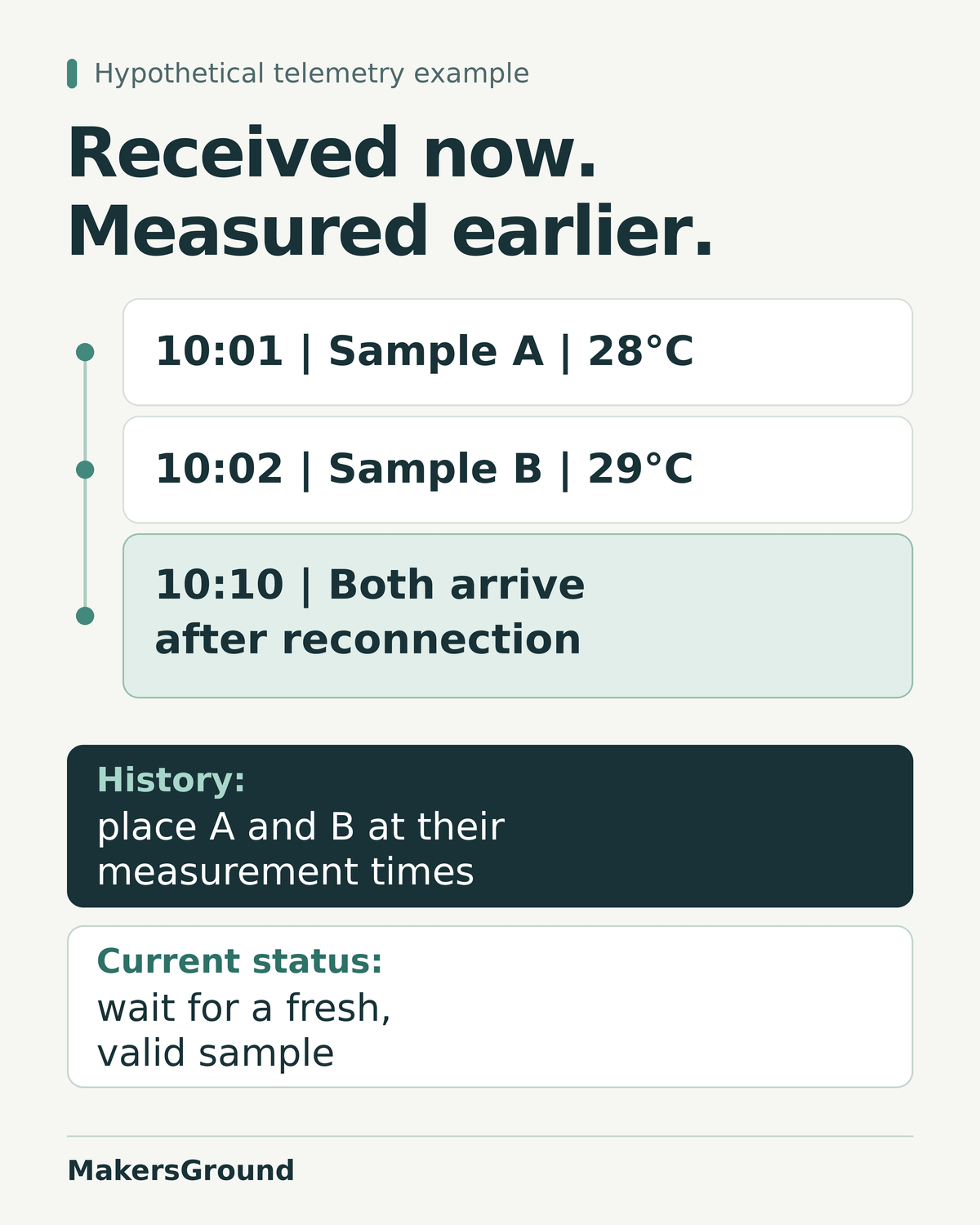
Consider a room monitor that records sample A at 10:01 with a value of 28°C and sample B at 10:02 with a value of 29°C. Connectivity is unavailable, so both remain queued. They reach the receiving application at 10:10. These values and times are illustrative, not a MakersGround test result.
The historical view places A at 10:01 and B at 10:02, preserving the device’s time-quality indication. Both also retain their 10:10 arrival time for diagnosis. If A is retried, the receiver uses its unchanged identity to recognize the accepted observation without adding another history entry or incrementing a counter again. If B arrives before A, the receiver’s ordering rule prevents A from replacing B merely because A was received later.
The current-status display applies its own freshness threshold. In this example, assume that neither queued sample meets that threshold at 10:10. The display remains stale or unavailable until a fresh, valid measurement is accepted. The threshold itself must come from the monitoring requirement; the illustration does not prescribe one for another product.
Re-evaluate freshness as time passes, including when no further messages arrive. Receiving a duplicate or replay must not reset the measurement’s age.
Make queue limits and catch-up behavior visible
Size the queue from the acquisition rate, maximum record size and intended outage duration, with room for metadata and storage overhead. State what happens when that bound is reached. Dropping the oldest sample, stopping acquisition and reducing sampling each have different consequences. The selected policy should appear in both the specification and the acceptance test.
Preserve a loss indicator or gap record where the product requires it. A smooth line through an unrecorded interval can suggest measurements exist when they do not. Separate “no change observed” from “no observations available.”
During reconnection, agree how historical replay shares bandwidth and processing with new samples. A large backlog should not indefinitely delay the information needed for the live view. Test a bounded replay rate and verify that the chosen priority does not lose older records or distort their timestamps. Record queue depth, age of the oldest pending sample, rejected records and unresolved gaps as diagnostic evidence.
Run an end-to-end acceptance test
Use a controlled development setup and known test records. Check the final stored data and user-visible status, not just the publisher log. Retain device, firmware, application and schema versions with each result.
- Short outage: acquire identifiable samples while disconnected, reconnect, and verify measurement time, arrival time and completeness.
- Lost acknowledgment: repeat an accepted record and verify that history and counts remain correct.
- Out-of-order replay and aging: deliver older and newer records in a different arrival order, then stop delivery and verify that the current-status display becomes stale at the agreed limit. Check history, ordering and freshness independently.
- Device restart: interrupt acquisition or persistence, restart, and check identity reuse, time quality and declared record loss.
- Clock correction: introduce a controlled clock adjustment and verify that uncertain ordering is flagged rather than hidden.
- Queue capacity: exceed the documented bound and verify the selected overflow policy and visible gap reporting.
- Conflicting duplicate: submit different content under an existing identity and confirm an explicit rejection or conflict path.
- Long catch-up: replay a backlog while acquiring fresh data and check both historical completion and live-view recovery.
Before approving the prototype, ask for one evidence bundle: the data contract, queue and acknowledgment policies, injected test sequence, stored output, and screenshots of the historical and current views. The team should be able to explain every missing, repeated, delayed or rejected record. A reconnect indicator alone cannot answer those questions.
Sources and scope
Sources checked on 24 October 2026. Technical references describe protocol or service behavior; the test design and example above are proposed engineering guidance. No field deployment, customer result or measured reliability claim is made.
- OASIS, MQTT Version 5.0, OASIS Standard dated 7 March 2019. Used for the QoS 1 duplicate-delivery distinction.
- AWS IoT Core, MQTT. Used for its service-specific acknowledgment and persistent-session descriptions.
- MakersGround, Pathfinder project record. Historical connected-device context; exact component responsibilities and current product availability are not established.