


An axis is ready for a positioning job only when its coordinate reference is trustworthy, its operating limits are meaningful and the controller has completed the required initialization. Seeing the carriage touch a switch is not enough. Validate the whole homing sequence, including the final position, repeated starts and the response when the expected reference never arrives.
This guide is for founders and engineering teams reviewing a prototype with a linear positioning axis. It turns “the machine homes correctly” into an acceptance record. The checks are development guidance, not a machine-safety assessment or permission to bypass guards, limits or protective functions. Fault tests belong in an appropriately safeguarded test setup under a qualified engineer’s control.
Separate the reference event from the resting position
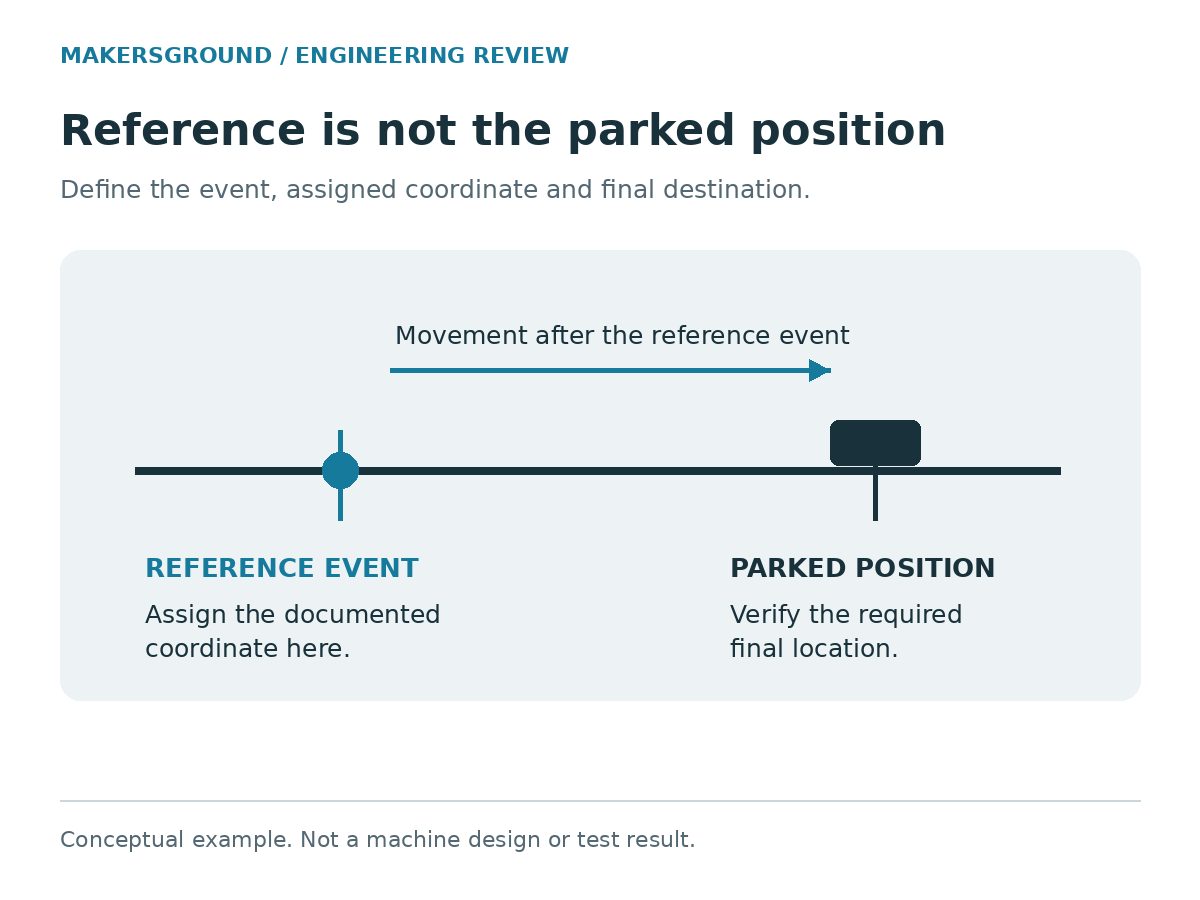
A reference signal identifies a position while the mechanism is moving. The axis may then decelerate, reverse or make a final move. The point assigned a coordinate and the position at which the mechanism eventually rests are therefore different concepts.
Beckhoff’s NC-guided homing documentation explicitly distinguishes the synchronization event from the subsequent standstill position. Its example is controller-specific, but the distinction is useful when writing a prototype requirement. Ask which event establishes the coordinate, which value is assigned there and where the axis must finish. Beckhoff: Homing.
Use three separate entries on the commissioning sheet: reference feature, assigned coordinate and final parked position. Also identify the coordinate frame. A machine reference and an offset used for a workpiece or fixture should not become interchangeable because both are called “zero” in a user interface.
Define the movement before choosing a switch
Write the expected sequence in plain language. For a switch-referenced axis, one possible sequence is to search for the switch, back away, approach the selected edge at a controlled speed, establish the coordinate and move to a defined park position. It is an example, not a universal recipe. Some systems use an encoder index, an absolute measurement system or a drive-managed procedure instead.
LinuxCNC documents separate search, latch and final-move settings. Its manual warns that search overshoot depends on speed, and distinguishes the detected reference coordinate from the final home destination. Use the selected controller’s documentation to resolve those meanings; do not copy parameter values from another machine. LinuxCNC: Homing Configuration.
Before authorizing motion, review the physical arrangement against that sequence. Mark available travel, the reference feature, the intended park position and any areas that must remain clear. Check the intended payload, cable movement and other axes’ positions. An acceptable sequence from the middle of travel might be unsuitable when the carriage starts beside the reference feature.
Our historical Gomicron engineering project documents mechanical design, PCB electronics, firmware and control within one product. That is the relevant MakersGround context for reviewing the mechanism and controller together. The public record does not establish Gomicron’s homing hardware, controller, procedure or repeatability. The validation plan here is not a reconstruction of that project.
Keep homing and travel protection distinct
A home input establishes a reference. A travel limit constrains motion. Some controllers support shared hardware, but that does not make the functions identical or make every shared arrangement appropriate. The selected drive, controller, mechanics and protective design must be reviewed together.
Software travel limits depend on a meaningful position reference. Beckhoff’s CNC documentation, for example, describes software-limit monitoring after homing completes. Treat this as a property to verify in the chosen system, not a universal promise about all controllers. Beckhoff: Task of homing and referencing.
Ask the engineering team to document what constrains travel before reference is established and what happens if the homing sequence fails. Do not accept a plan that depends on disabling protection to make the demonstration finish. Changes to protective functions require their own assessment, outside this article.
Measure repeated reference finding, not a displayed zero
A screen that returns to 0.000 after every cycle is displaying a coordinate assigned by software. It does not independently show that the carriage returned to the same physical location. Use a suitable independent measurement arrangement at a defined mechanical feature, with resolution and uncertainty appropriate to the acceptance tolerance.
Define the test before collecting results. Record the initial positions, load, warm or cold state, reference approach direction, configured speeds, number of repetitions and measurement method. Include representative starts on both relevant sides of the reference feature where the design permits them. Avoid changing the setup between repetitions without recording it.
Keep every measured position, not only the average. Calculate the observed spread and compare the complete result with the agreed requirement, taking measurement uncertainty into account. Do not turn a small successful sample into a lifetime reliability claim. A repeatability result also does not, by itself, establish positioning accuracy across the rest of travel.
If a result changes when the approach speed changes, investigate the signal-detection path as well as the mechanism. Beckhoff describes how sampling can make referencing velocity-dependent when suitable hardware latching is absent. That is a reason to examine the actual input and capture arrangement, not to assume that purchasing a different switch will resolve the problem.
A hypothetical acceptance example
Consider a benchtop inspection carriage that must return to a known starting region before each new inspection sequence. The requirement is not simply “home on startup.” The team agrees which physical feature will be measured, the permissible reference-position variation, the permitted initialization duration and the state required before inspection can start. Those values come from the inspection process and its measurement needs, not from this example.
The test record keeps successful starts separate from fault cases:
- Normal start: the axis completes the documented sequence, reaches the expected parked region and enables the inspection sequence only after completion.
- Reference input already active: the controller follows the documented handling for that initial state rather than accepting an unexplained shortcut.
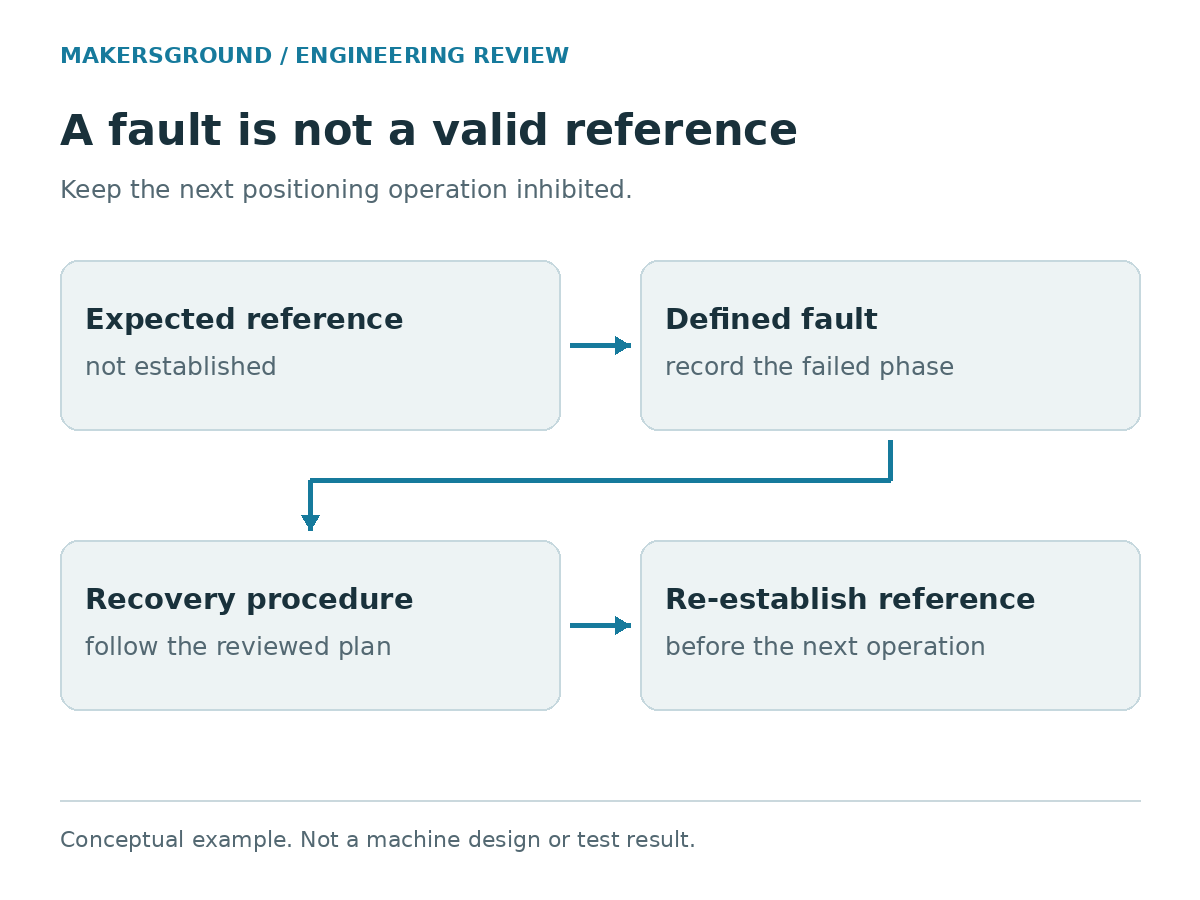
- Expected reference absent: the controlled test ends with a defined fault within its specified bounds. The system does not announce a valid reference.
- Interrupted initialization: the reference-valid state reflects what is actually known after interruption. A new start follows the documented recovery procedure.
- Repeated initialization: independent measurements meet the agreed acceptance rule across the chosen operating conditions.
This is a proposed test structure, not a MakersGround customer result. Do not induce missing-signal or motion faults on operating equipment. The test engineer must select a method that preserves the safeguards appropriate to the mechanism.
Make failure visible to the application
The operator interface, motion controller and application should agree about whether the reference is valid. Give “not initialized,” “initializing,” “ready” and “fault” distinct meanings. A command being accepted is not the same as initialization completing.
Specify which events invalidate the reference. Depending on the system, these can include a power interruption, a relevant configuration change, loss of position information or movement that the controller cannot account for. Do not assert that every absolute encoder eliminates every initialization requirement; the measurement system and machine configuration need their own documented validity checks.
Record a fault reason that helps the next person investigate: which phase was active, what input state was observed and which expected condition was not reached. Preserve the distinction between clearing a message and restoring a trustworthy reference. For a broader recovery review, see our power-failure recovery checklist.
What to keep in the prototype handover
The handover should let another engineer reproduce both the configuration and the acceptance decision. Include the axis and unit identifiers; mechanical and electrical revisions; controller and firmware versions; switch or encoder identification; reference and park definitions; parameter export; test conditions; raw position measurements; fault-test outcomes; and unresolved limitations.
Attach the record to the actual tested build. If the reference bracket moves, the sensor changes or the detection timing is altered, identify which checks must be repeated before using the previous result. Our hardware prototype revision checklist explains how to keep that connection between a design change and its test evidence.
For an axis prototype, a useful acceptance statement is specific: this build established its reference, completed the required final movement and responded correctly to the tested abnormal conditions. That statement is more useful than a video of a switch being touched, and narrower than a claim that the entire machine is validated.
Sources and scope
Primary technical sources opened and checked on October 27, 2026. Vendor behavior is cited as an example and must be checked against the selected controller, drive and software version. The proposed acceptance workflow and hypothetical carriage are original editorial synthesis. No source establishes a MakersGround installation, test result or certification.
- LinuxCNC, Homing Configuration: reference coordinates, search and latch behavior, final position and travel considerations.
- Beckhoff, Homing: NC-guided referencing, synchronization and standstill distinction.
- Beckhoff, Task of homing and referencing: coordinate initialization, software-limit context and input-capture considerations.
- MakersGround, Gomicron project record: documented historical engineering scope only.